
Why TCR Repeatability and Long-Term Stability Define Precision Resistor Performance
In the world of precision electronics, resistor selection is often treated as a simple specification exercise. Engineers compare tolerance, nominal resistance, power rating, and Temperature Coefficient of Resistance (TCR), then assume the system will maintain accuracy over time.
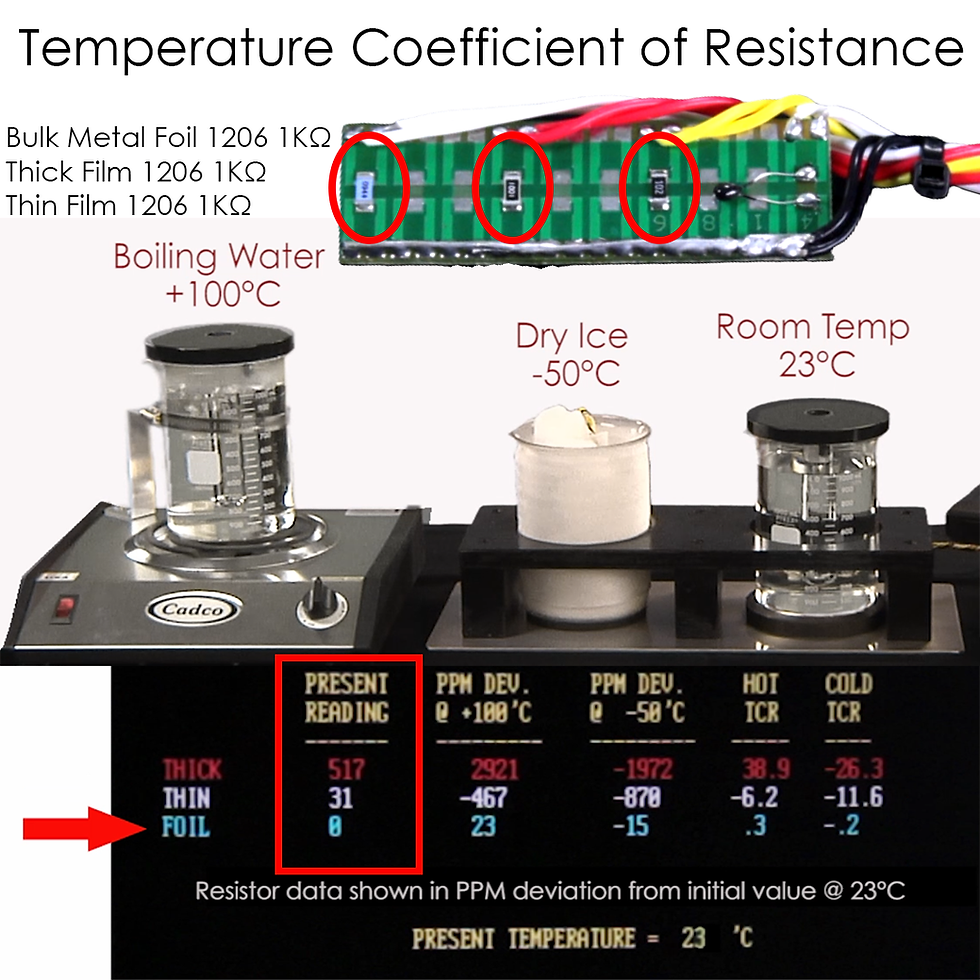
However, in real-world industrial and instrumentation environments, initial specifications alone rarely determine long-term performance. What separates reliable systems from unstable ones is not day one accuracy, but how well that accuracy survives years of thermal stress, environmental exposure, and cycling.
A recent industry discussion initiated by Yuval at VPG, explores a common challenge faced in precision instrumentation systems: excellent initial TCR performance followed by unexpected calibration drift after prolonged operation. It highlights why TCR repeatability and long-term thermal stability have become critical evaluation criteria for modern high-accuracy applications and why advanced resistor technologies such as VPG Bulk Metal Foil continue to define the benchmark for precision performance.
What TCR Repeatability Really Means
Temperature Coefficient of Resistance (TCR) describes how much a resistor’s value changes with temperature. In high-precision systems, even extremely small resistance variations can affect measurement accuracy, signal conditioning, sensor calibration, and control stability.
In practice, “TCR repeatability” is used in two different ways.
1. Repeatable Measurement Across Components
The first interpretation focuses on manufacturing consistency.
When engineers test batches of precision resistors, they expect resistance behavior to cluster tightly from part to part and lot to lot. If multiple resistors claim the same TCR specification but exhibit significantly different thermal responses, system matching becomes difficult and calibration complexity increases.
This form of repeatability matters heavily in applications such as:
Precision data acquisition
Medical instrumentation
Aerospace electronics
High-resolution weighing systems
Industrial automation controls
Metrology equipment
In these environments, component consistency directly affects production yield and measurement confidence.
2. Long-Term Stability of a Single Resistor
The second and often more critical interpretation involves time-based stability.
A resistor may demonstrate excellent TCR during initial qualification testing but gradually drift after months or years of thermal cycling. In this case, the issue is not the original measurement accuracy but the resistor’s inability to maintain its thermal behavior throughout operational life.
This distinction is essential because many systems are calibrated only once during manufacturing. If resistance characteristics shift over time, the entire instrument can drift outside specification without any visible hardware failure.
The Industry Challenge: Precision Drift After Thermal Cycling
A manufacturer of precision instrumentation equipment faced exactly this challenge during deployment of a high-accuracy monitoring system used in temperature-sensitive industrial environments.
During production validation, the engineering team observed outstanding resistor performance:
Tight initial TCR values
Excellent matching across production batches
Stable calibration during laboratory testing
Strong short-term measurement repeatability
On paper, the design exceeded expectations.
However, several months after field deployment, calibration inconsistencies began appearing in installed systems. Measurements that originally aligned within extremely tight tolerances gradually started drifting outside acceptable ranges.
The issue became more visible in systems exposed to repeated thermal cycling caused by:
Daily temperature fluctuations
Internal self-heating
Power cycling
Environmental operating variations
Long-duration operational stress
At first, engineers suspected sensor instability, firmware offsets, or external environmental influences. But deeper analysis revealed a different root cause:
The resistor network’s TCR behavior had changed over time.
Why Initial Accuracy Is Not Enough
The investigation highlighted an important engineering reality: identical initial TCR specifications do not guarantee identical long-term behavior.
Many resistor technologies can deliver impressive initial performance under controlled laboratory conditions. The challenge emerges when those components experience real-world stress.
Thermal cycling creates microscopic mechanical and material changes within resistor structures. Over time, these effects can alter resistance characteristics enough to impact ultra-precision systems.
A resistor may pass qualification testing
Calibration may initially appear perfect
Production yields may look excellent
Yet long-term field performance may still degrade
This phenomenon becomes increasingly important as systems demand:
Higher resolution measurements
Longer service life
Lower maintenance intervals
Reduced recalibration requirements
Greater environmental robustness
For high-precision industries, accuracy is no longer the finish line. Stability over time has become equally important.
Thermal Reality in Precision Electronics
A common mistake is assuming TCR behaves linearly and consistently over time.
In reality, resistance behavior under temperature stress is influenced by:
Material composition
Mechanical stress relaxation
Moisture sensitivity
Substrate interaction
Power-induced heating
Environmental aging
As many engineers know, TCR often looks good until real thermal stress begins.
This is especially relevant in systems where tiny measurement changes can produce major downstream effects. Examples include:
Precision Weighing Systems
Industrial weighing systems rely on stable signal conditioning to maintain calibration integrity. Even small resistor drift can introduce measurable weighing inaccuracies over time.
Medical and Scientific Equipment
Diagnostic instruments require consistent analog accuracy across years of operation. Drift can compromise reliability and regulatory compliance.
Aerospace and Defense Electronics
Extreme environmental cycling places enormous stress on passive components. Long-term resistor stability becomes mission critical.
Metrology and Calibration Equipment
Reference-grade systems demand repeatable thermal performance over extended operational lifespans.
In all these environments, thermal stability becomes a strategic design requirement rather than a secondary specification.
The Solution: Technology Designed for Stability
To address long-term drift concerns, the instrumentation manufacturer evaluated advanced resistor technologies specifically engineered for thermal stability rather than only initial specification performance.
The engineering team ultimately prioritized several key factors:
Ultra-stable long-term TCR behavior
Resistance to thermal cycling effects
Tight part-to-part consistency
Minimal drift under operational stress
Proven field reliability over extended periods
This evaluation led them toward foil resistor technology, particularly Bulk Metal Foil resistors, known for strong thermal and long term stability.
Unlike many conventional resistor technologies, Bulk Metal® Foil resistors are specifically engineered to minimize thermally induced resistance shifts over time. Their construction helps reduce stress-related drift mechanisms that commonly affect long-duration precision applications.
As a result, the manufacturer observed:
Improved calibration retention
Reduced long-term drift
Greater system repeatability
Lower recalibration frequency
Enhanced field reliability
Most importantly, the systems maintained precision performance not only during initial testing but throughout extended real-world operation.
Key Lessons for Precision System Designers
This case reflects a broader industry shift in how engineers evaluate passive components.
Historically, resistor selection focused heavily on initial datasheet specifications. Today, system designers increasingly recognize that lifetime stability is equally important.
Several critical lessons emerged from this experience:
1. Initial TCR Performance Does Not Tell the Whole Story
A resistor that performs well during qualification testing may still drift significantly after thermal aging and operational cycling.
2. Long-Term Stability Must Be Evaluated Early
Waiting until field deployment to assess drift behavior can create costly recalibration, maintenance, and reliability issues.
3. Thermal Cycling Is the Real Test
Precision components should be evaluated under realistic operational stress conditions rather than ideal laboratory environments alone.
4. Technology Choice Matters
Different resistor technologies may share similar headline specifications while delivering dramatically different long-term performance outcomes.
5. Stability Is a Competitive Advantage
For manufacturers of precision equipment, long-term accuracy directly impacts customer trust, maintenance costs, and product reputation.
Conclusion
Precision electronics operate in a world where tiny variations can create major consequences. In such environments, TCR repeatability is not just a datasheet number. It reflects how reliably a resistor maintains its behavior across time, temperature, and stress.
This case study demonstrates why the industry increasingly views long-term stability as the true measure of precision performance. Initial calibration may establish accuracy, but sustained thermal stability determines whether that accuracy survives real-world operation.
As instrumentation systems continue demanding tighter tolerances, longer service life, and higher reliability, resistor technology selection becomes more strategic than ever.
For applications where precision, repeatability, and long-term reliability genuinely matter, advanced technologies like VPG Bulk Metal Foil continue to set the benchmark for enduring performance under thermal reality.


Comments